

If your product runs AI inference, serves a language model or transcodes video, the GPU bill quickly becomes one of your largest costs. You have two common options: rent GPUs by the hour from a cloud provider, or pay a fixed monthly price for a dedicated GPU server. This guide compares both so you can match the model to your workload.
What is a GPU server?
A GPU server is a computer built around one or more graphics processing units (GPUs) that handle massively parallel calculations. That makes them the standard hardware for neural network inference, model training, 3D rendering and video encoding. A GPU server combines the cards with server-grade CPUs, plenty of RAM, fast storage and a network connection.
How cloud GPUs work
Cloud providers bill GPU instances per hour or per second. You start an instance in minutes and shut it down when the job ends:
- Instant start. You can test an idea the same afternoon, without a contract.
- Elastic scaling. You add ten GPUs for a training run and release them the next day.
The trade-offs appear as usage grows. Costs rise with every hour the instance runs, and many providers charge separately for outbound traffic (egress), persistent storage and snapshots. Instances often run on virtualized or shared hosts, so performance can vary. Popular GPU models are not always available in the region you want, especially when demand spikes.
How dedicated GPU servers work
A dedicated GPU server is a whole physical machine reserved for you and billed at a fixed monthly price.
- Predictable cost. The price stays the same whether the GPU works two hours or twenty-four.
- Consistent performance. There are no noisy neighbours, so latency and throughput stay stable.
- Full control. You choose the operating system, kernel, driver and CUDA versions.
- Data on hardware you control. Models, prompts and customer files stay on a single machine that only your team accesses.
The costs are different, not absent. You usually commit for several months, you wait for the server to be delivered, and your team manages the software stack, updates and monitoring.
Dedicated GPU server vs cloud GPU: side by side
| Criterion | Cloud GPU | Dedicated GPU server |
|---|---|---|
| Billing | Per hour or second; egress and storage often extra | Fixed monthly price, prepaid for a period |
| Performance consistency | Can vary on shared or virtualized hosts | Stable; the whole machine is yours |
| Control | Limited to what the platform exposes | Full root access, own OS, drivers and kernel |
| Data privacy | Data sits on a shared multi-tenant platform | Data stays on a single-tenant physical server |
| Scaling | Up and down in minutes | Add servers over days or weeks |
| Setup time | Minutes, if capacity is available | Days to a couple of weeks |
| Best for | Experiments, short training runs, bursty jobs | 24/7 inference, LLM APIs, rendering and video pipelines |
Which one fits your workload?
The key question is how many hours per day your GPU actually works. Hourly pricing favours short, irregular jobs. A fixed price favours steady use. Use this checklist:
- The GPU is busy for many hours every day. A dedicated server is likely the better deal, because you stop paying for each hour separately.
- You serve a model to users around the clock. Choose dedicated. Stable latency matters more than elastic scaling.
- Load comes in unpredictable spikes. Cloud GPUs absorb the peaks without idle hardware in between.
- You are still testing models or frameworks. Start in the cloud and move once the workload settles.
- You move large volumes of data out. Check egress fees; a server with included monthly traffic is easier to budget.
- You need a specific driver, kernel or OS. Dedicated hardware gives you that freedom.
- Clients ask where their data is processed. A single-tenant server in a known data center gives a clear answer.
You do not have to pick only one. Many teams run their steady baseline on dedicated servers and rent cloud GPUs for occasional training runs or traffic peaks. Count your real GPU hours for last month, then compare both options.
Dedicated GPU servers at IPHOST
IPHOST offers GPU server hosting from its own ISO/IEC 27001 certified data center in Chișinău, Moldova, in Europe and outside the EU. We do not rent hourly cloud GPUs; every plan is a whole physical HPE server:
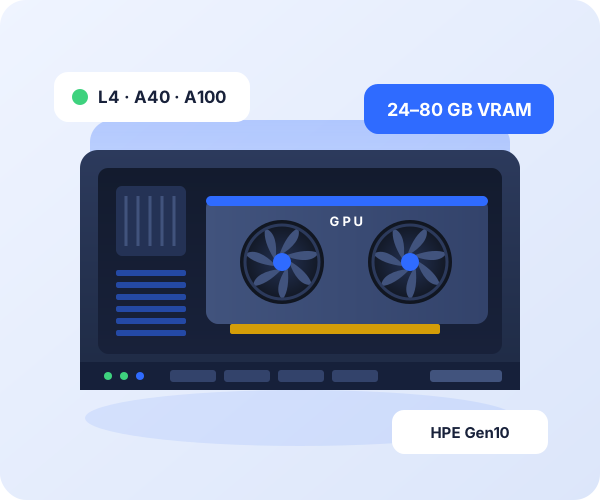
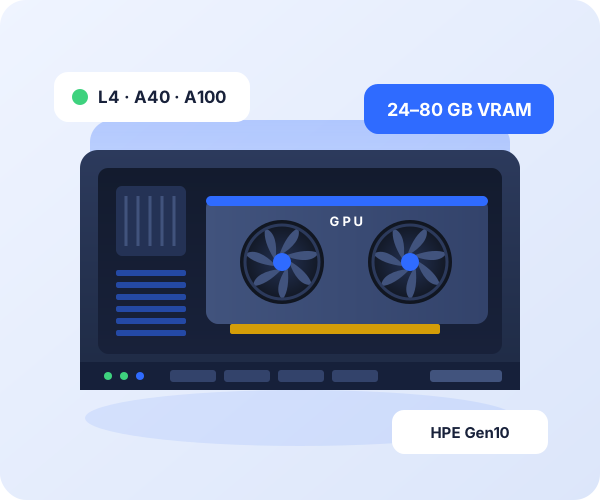
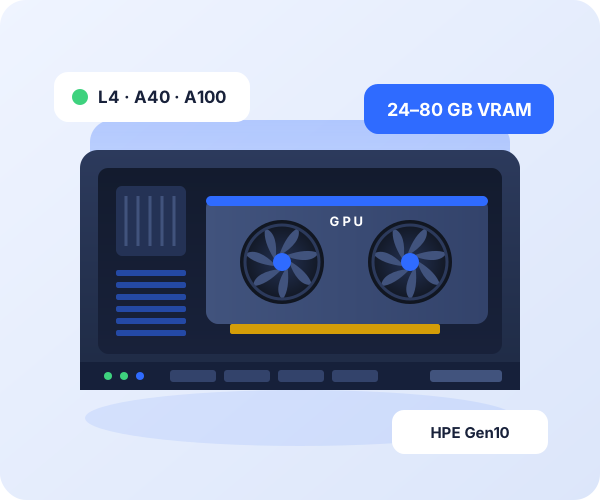
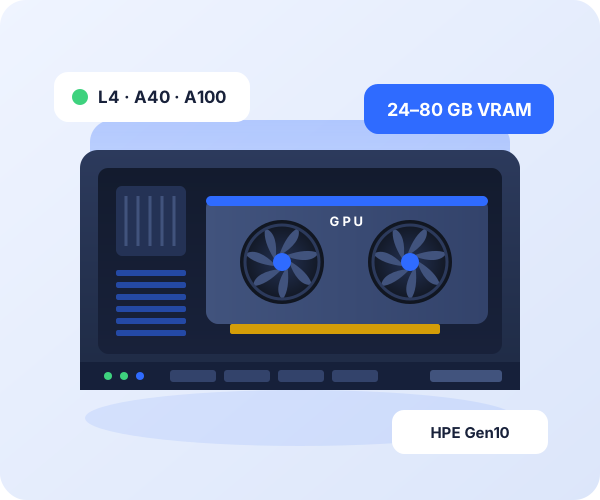
- NVIDIA L4 24 GB on an HPE DL360 Gen10 with one Xeon Gold 6248 and 128 GB RAM, an efficient choice for inference and video transcoding.
- NVIDIA A40 48 GB on an HPE DL380 Gen10 with two Xeon Gold 6230R and 192 GB RAM, for larger models and rendering.
- 2x NVIDIA A100 40 GB each on an HPE DL380 Gen10 with two Xeon Gold 6230R and 256 GB RAM, for demanding workloads and LLM hosting.
Every server includes two 1.6 TB SAS SSDs, a 1 Gbps port with 30 TB of monthly traffic, one IPv4 address, basic DDoS protection, iLO remote management and full root access. We install Linux or Windows Server with the NVIDIA driver and CUDA ready to use. Servers are sold on pre-order with delivery within 14 days, and you get a full refund if we deliver late. Billing runs every 3 months in advance, and paying for 12 months lowers the monthly price by up to 14%. You can pay by card, bank transfer or cryptocurrency.